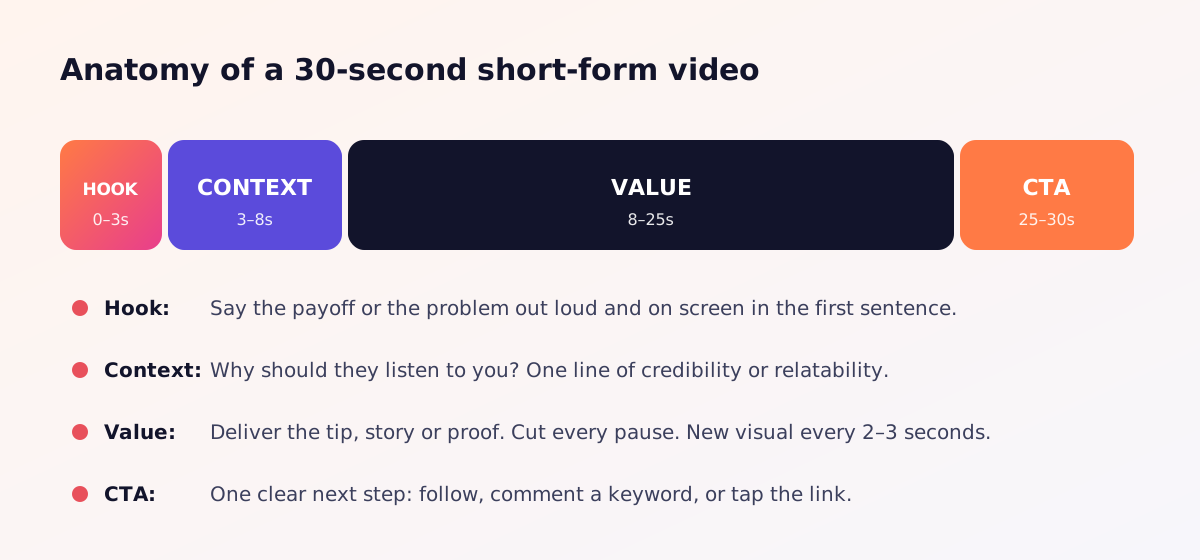
On short-form video, the first two or three seconds decide everything. If your opening doesn't give people a reason to stay, it doesn't matter how good the rest of the video is — they've already swiped. Below are twelve hook formulas we use for clients every week, with examples you can adapt for your own brand.
What makes a hook work
A strong hook does at least one of these jobs instantly: it names a problem the viewer has, promises a specific payoff, or creates a gap in their knowledge they want closed. Weak hooks are vague (“Hey guys, today I want to talk about…”) or slow (“So, a lot of people ask me…”). Strong hooks are specific and start mid-thought.
And remember: a hook is more than the words. It's the first frame, the on-screen text, and the movement. Say your hook out loud, put it in large text on screen, and start with motion — walking toward the camera, a hand reaching into frame, a quick cut.
The 12 formulas
1. The direct call-out
Formula: “If you're a specific person who specific situation, watch this.”
Example: “If you're a dentist who's tired of empty appointment slots, watch this.”
Calling out exactly who the video is for makes the right people stop and lets the wrong people leave — both good outcomes.
2. The mistake
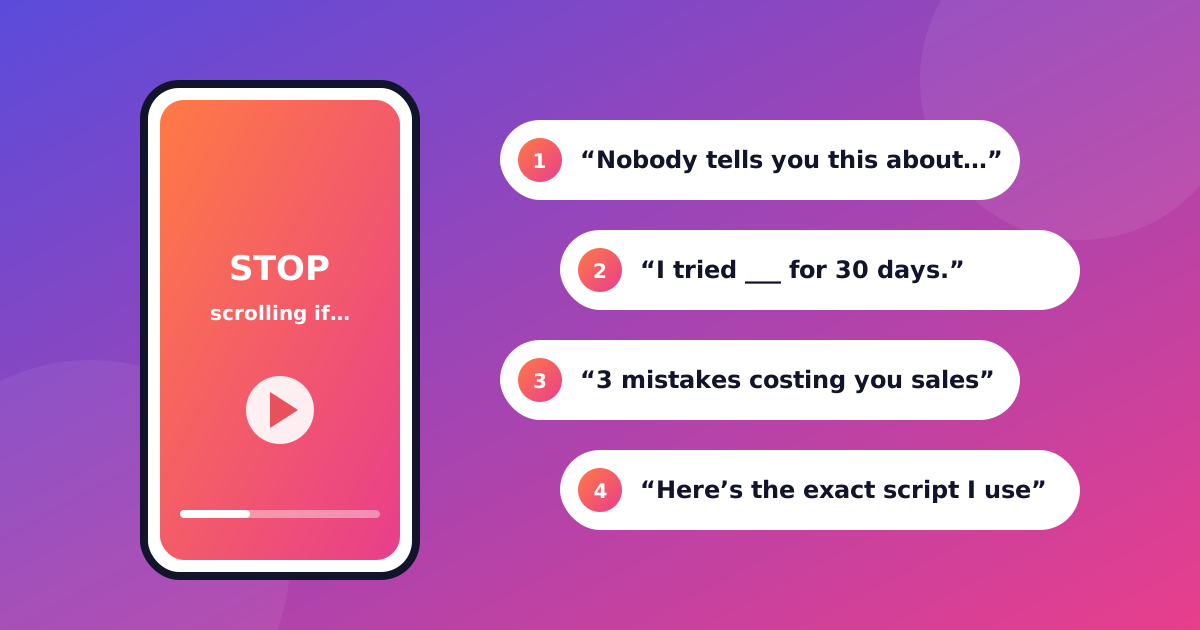
Formula: “Number mistakes that are costing you result.”
Example: “3 Instagram mistakes that are costing you customers.”
People are more motivated to avoid losses than to chase gains. Mistakes make viewers ask, “Am I doing that?”
3. The secret
Formula: “Nobody tells you this about topic…”
Example: “Nobody tells you this about running Facebook ads.”
Use it only when you genuinely have a non-obvious insight. Over-promising here destroys trust fast.
4. The experiment
Formula: “I tried thing for time period. Here's what happened.”
Example: “I posted a Reel every day for 30 days. Here's what happened.”
Stories with an outcome create natural curiosity — viewers stay to see the ending.
5. The contrarian take
Formula: “Stop common advice. Do this instead.”
Example: “Stop posting at the ‘best time’. Do this instead.”
Challenging conventional wisdom triggers attention — and comments, which help reach.
6. The result first
Formula: “This is how result happened.” (show the result on screen)
Example: “This is how one carousel filled a month of bookings.”
Lead with the payoff, then explain the path. Only use real results you can stand behind.
7. The how-to
Formula: “How to desirable outcome in short timeframe / few steps.”
Example: “How to write a week of captions in 20 minutes.”
Simple and reliable — especially for educational accounts.
8. The question
Formula: “Why does frustrating thing keep happening?”
Example: “Why do your Reels get views but no sales?”
A question the viewer has already asked themselves feels personal.
9. The list tease
Formula: “Number things I'd use if I were starting X today — number N is my favorite.”
Example: “5 free tools I'd use if I started a brand today — number 4 is underrated.”
Teasing a specific item keeps people watching to the end, which boosts completion rate.
10. The relatable moment
Formula: “POV: you familiar frustrating or funny situation.”
Example: “POV: you spent 3 hours on a post and it got 11 likes.”
Relatability earns shares, and shares are one of the strongest signals for reaching new people.
11. The before and after
Formula: “Before vs. after change.” (split screen or quick cut)
Example: “Our client's profile before vs. after a rebrand.”
Visual transformation is instantly understood, even with the sound off.
12. The script reveal
Formula: “Here's the exact script / template / message I use to result.”
Example: “Here's the exact DM I send when someone asks for pricing.”
Specific, usable assets get saved — and saves tell the algorithm your content is valuable.
How to deliver the hook
- Text on screen within the first second. Many people watch with the sound off.
- No intros, no logos, no “hi everyone”. Start with the hook itself.
- Match the visual to the words. If you say “3 mistakes”, show “3 MISTAKES” on screen.
- Pay off the promise. A hook that the video doesn't deliver on trains your audience to ignore you.
Measure, then repeat
Look at the retention graph in your analytics. If a large share of viewers drop off in the first three seconds, the hook is the problem. If they drop off in the middle, the pacing is. Keep a simple spreadsheet of each hook you use and its average watch time — after a month, you'll know exactly which formulas your audience responds to.