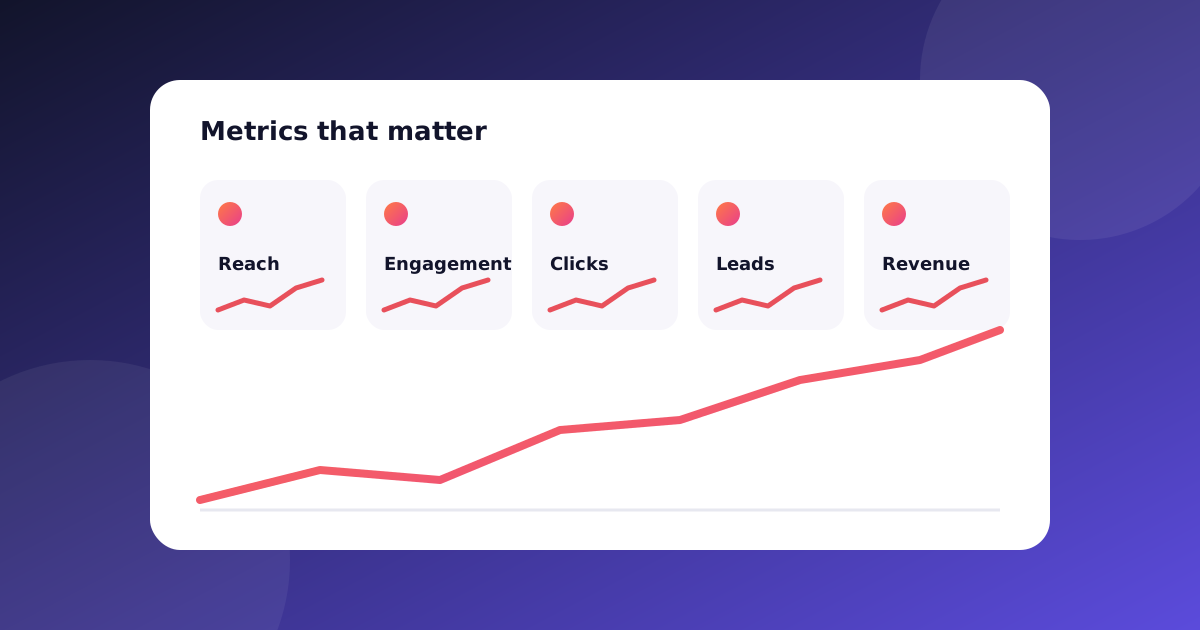
Social platforms give you dozens of numbers. Most of them make you feel good or bad without telling you what to do next. If you're running social media for a business, five metrics tell you nearly everything you need to know — and they line up neatly from first impression to final sale.
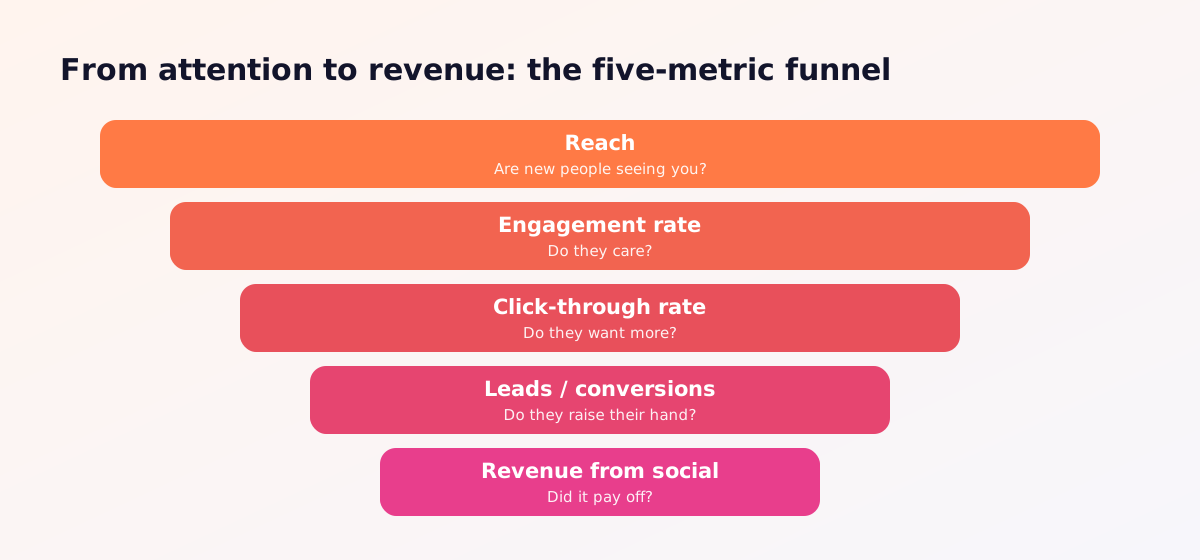
1. Reach (especially non-follower reach)
What it is: the number of unique accounts that saw your content.
Why it matters: you can't grow if new people never see you. Most platforms now split reach into followers and non-followers — the non-follower number tells you whether your content is being recommended to new audiences.
If it's low: work on hooks, use formats the platform is currently pushing (often short-form video), and post more consistently.
2. Engagement rate
What it is: interactions (likes, comments, shares, saves) divided by reach, shown as a percentage.
Why it matters: it tells you whether the people who saw your content cared. Use reach, not follower count, as the denominator — it gives a truer picture of how compelling each post is.
Not all engagement is equal. Shares and saves are the strongest signals: a share puts you in front of new people, and a save means the content was genuinely useful. Comments are next, likes are the weakest.
3. Click-through rate (CTR)
What it is: the percentage of people who clicked a link — in your bio, a Story link, a post link or an ad.
Why it matters: clicks mean someone wants more than a scroll. It's the bridge between attention and action.
If it's low: your call to action might be unclear, or the content isn't connected to what you sell. Make the next step obvious and tell people why they should take it.
4. Leads and conversions
What it is: the number of people who took a meaningful action — booked a call, joined your email list, requested a quote, filled out a form or started a purchase.
Why it matters: this is where social media starts to pay for itself. A post with modest reach that brings in a handful of qualified leads beats a viral post that brings none.
How to track it: use UTM parameters on every link you share so your website analytics can attribute visits to the right platform and post. Add “How did you hear about us?” to your forms, and tag DM leads in a simple tracker.
5. Revenue from social
What it is: sales you can reasonably attribute to social media — through tracked links, ad conversions, discount codes or customer answers.
Why it matters: it's the number that tells you whether your time and budget are well spent. Pair it with cost (ad spend plus the time or fees spent on content) to estimate your return.
Attribution will never be perfect. Someone might watch your Reels for three months and then search for you on Google. That's fine — look for trends, not perfect precision.
The vanity metrics to stop obsessing over
- Follower count: useful context, but followers who never see or engage with your posts don't help your business.
- Likes alone: easy to give, weak signal of intent.
- Impressions: counts repeat views from the same people — reach is cleaner.
- Video views without watch time: a “view” can be a fraction of a second. Average watch time and completion rate say much more.
Build a simple monthly scorecard
Once a month, record these five numbers in a spreadsheet, one row per month, one tab per platform. Then ask three questions:
- Which metric moved the most, up or down?
- Which posts drove the biggest changes?
- What one thing will we do more of — and less of — next month?
That's it. Fifteen minutes a month with the right five numbers is worth more than hours scrolling through every chart your analytics dashboard offers.
Diagnosing problems with the funnel
- Low reach: content isn't being distributed — fix hooks, formats and consistency.
- Good reach, low engagement: content isn't resonating — revisit your audience and topics.
- Good engagement, low clicks: no clear next step — strengthen your calls to action.
- Good clicks, few leads: the landing page or offer is the problem.
- Lots of leads, low revenue: look at lead quality and your sales follow-up.
Read the funnel from top to bottom, fix the first leak you find, and you'll always know where to focus next.